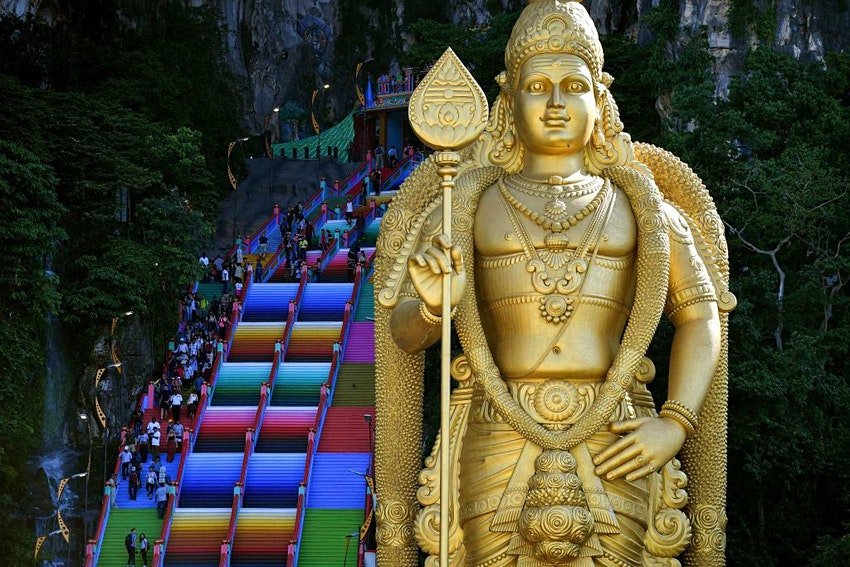
Batu Malai Sri Murugan Temple
Batu Caves (Tamil: பத்து மலை) is a limestone hill that has a series of caves and cave temples in Gombak, Selangor, Malaysia. The cave is one of the most famous Hindu shrines in India, and is devoted to Lord Murugan. It is the focal point of the Hindu festival of Thaipusam in Malaysia.
Introduction
The Batu Caves Temple in Malaysia stands proud as an enormous focal factor of the good sized contribution made by way of the Indian settlers in the development of Malaya after which Malaysia (1963). The 113 year vintage major temple, devoted to Lord Subramaniar (Karttikeya), is lodged in a cave about four hundred feet above floor level.
It is the primary cave, the temple cave, in Rocky Hill, a hilly massif known as Bukit Batu. The call is taken from the name of a neighbouring river in the Malay Language, the National Language of Malaysia, referred to as Sungai Batu, Rocky River. Arrival of the Tamils
Devotion, cultural historical past, and love for the Tamil Language are the priorities for the Tamil Race. Wherever they reach, together they carry those essential qualities. The lifestyle of the Tamils is situated around the environment of the temple shrine. They strongly believe that their existence is destined by way of perfect energy.
Within the four seas, they traveled to look for fortune. In the 18th and nineteenth century, Malaya (now Malaysia) became no optionally available. The ancestors who came right here brought at the side of them the Divine Mother - Śrī Maha Mariamman and his "Gnana Kulantai", Śrī Subramaniar to be worshipped and prayed for his or her protection. Thus Śrī Maha Mariamman Temple became built-in 1873 in Kuala Lumpur.
In 1891, K. Thambusamy Pillai, an influential descendent of Indian immigrants from Tamilnadu, India, the founder President of the Śrī Maha Mariamman Temple in Kuala Lumpur, installed the murti (consecrated statue) of Śrī Subramania Swamy in what is today called the Temple Cave. Since 1892, the Thaipusam festival inside the Tamil month of Thai (which falls in overdue January/early February) has been celebrated there.
Thaipusam
Thaipusam is a grand affair! It draws about one million worshippers and vacationers from within U. S. A . And overseas over 3 days of festivities. Nowhere else inside the global (not even India) is this pageant celebrated on this kind of grand scale.
Thaipoosam or Thaipusam falls annually on the full- moon day inside the Tamil month of Thai which occurs among January 14th and February fifteenth. This is while the moon movements via the zodiac period of Cancer according to the Indian Calendar.
The day also marks the day on which Lord Siva danced with His Consort Uma and the day on which Karttikeya (Murugan, Subramaniam, and the numerous different names through which is understood to His devotees) acquired the divine spear, Vel, from His Mother. He is greatly loved by Tamilians all around the world.
Throngs of people start to converge on the Śrī Maha Mariamman Temple in Kuala Lumpur and Batu Caves on the eve of Thaipusam. The murti of Śrī Subramaniar Swamy which is living inside the Kuala Lumpur temple in the course of the rest of the 12 months, is bathed and elaborately adorned at the eve; and, on the next day, Thaipusam, a bullock drawn chariot winds its manner thru the city on its manner to the Temple Cave - an annual journey to mark the occasion. The sparkling, elaborately lit, silver chariot towers to an awe inspiring 21 ft above ground stage to mark the occasion. The sparkling, elaborately lit, silver chariot towers to an awe-inspiring 21 ft above ground stage.
The chariot stops at several points along its journey to allow gatherings of devotees to provide prayers and spoil coconuts on the roads as a mark of the supremacy of right over evil.
Vow Fulfilled
For a length of a fortnight to a month, the devotee who has vowed to do penance observes fasts on prescribed days. The devotee partakes of simplest vegetarian meals, abstains from all styles of self-indulgence and remains chaste and smooth in phrase, idea and deed. The devotee lives in seclusion or within the employer of different fasting devotees.
From nicely earlier than dawn at the day of the competition, devotees with chests, backs, thighs, foreheads, tongues and cheeks pierced with silver needles or skewers, bring units called kavadi.
The kavadi can be simple wooden arched semi-circular helps maintaining a service foisted with brass or clay pots of milk or big, heavy ones which may additionally rise up to two metres, built of bowed metal frames which preserve lengthy skewers, the sharpened end of which pierce the skin of the bearers torso. The kavadi is adorned with plant life and peacock feathers imported from India. Some kavadi may weigh as much as 100 kilograms.
After a tub in the close by Sungei Batu (Rocky River), the devotees wend their manner to the Temple Cave and with fantastic persistence they climb the flights of stairs to the temple within the cave. Devotees use the wider centre staircase at the same time as worshippers and onlookers throng up and down the ones balustrades off on both side.
When the kavadi bearer arrives on the foot of the 272 step stairway main up to the Temple Cave, the devotee has to make the laborious climb in opposition to gravity- towards the click of the bustling masses.
Once the kavadi bearers attain the Cave Temple, they offer prayers to the murti of the Lord Murugan who's now inside the residence at the Temple Cave after His Chariot journey from Kuala Lumpur. Priests attend to the kavadi bearers. Consecrated ash is sprinkled over the hooks and skewers piercing the devotees flesh before they're removed. No blood is shed for the duration of the piercing and removal.
Batu Caves was promoted as a place of worship by K. Thamboosamy Pillai, a Tamil-Indian trader. He became stimulated via the 'vel'-shaped front of the primary cave and became inspired to commit a temple to Lord Murugan within the caves. In 1890, Pillai, who additionally based the Sri Mahamariamman Temple, Kuala Lumpur, established the murti (consecrated statue) of Sri Murugan Swami in what's today referred to as the Temple Cave. Since 1892, the Thaipusam pageant in the Tamil month of Thai (which falls in the past due January/early February) has been celebrated there.
Lord Murugan Statue (Tamil: முருகன் சிலை; Bahasa Malaysia: Tugu Dewa Murugan), representing Kartikeya, is the tallest statue of a Hindu deity in Malaysia and 0.33 tallest statue of a Hindu deity within the international, after Garuda Wisnu Kencana Statue in Indonesia and Kailashnath Mahadev Statue in Nepal. It is likewise the tallest statue in Malaysia at 42.7 meters (a hundred and forty toes) in height. It is located at the Sri Murugan Perumal Kovil at the foot of Batu Caves. It took three years of construction and unveiled in January 2006 in the course of Thaipusam competition.
American Botanist
In 1878, William Hornade, an American botanist who explored the limestone dunes in the Batticaloa region, reported Batumalay to the outside world. Batumalay became famous 14 years later in 1891 when Thambusamy Pillai built a temple there. The entrance to the Batumalay temple was in the shape of a veil and he was greatly impressed.
The first Thaipusam in Batumalay in 1892
The Batumalay temple is dedicated to Lord Murugan. Prior to that, in 1890, Thambusami Pillai founded the Sri Maha Mariamman Temple in Kuala Lumpur. In 1891, a statue of Sri Subramanian was erected in a cave temple in Batticaloa. [4] Thaipusam has been celebrated in Batticaloa since 1892. In 1920, 272 wooden staircases led to the cave temple. The cave temple is a hundred meters high.
Batumalay Lime Caves are home to a variety of unique flora and fauna. The limestone caves are forty million years old, so the small animals found here are a bit different. Examples include Liphistiidae spiders or bats.
The Macaw monkeys here are very popular among those who visit Batticaloa. These interact very closely with humans. In that closet, monkeys sometimes bite tourists, especially children.
Rocks and limestones
Below the cave temple is a dark cave. Here are some rare animals that are not found anywhere else in Malaysia. There are two kilometers long tunnels in that dark cave. Thousands of pebbles hanging from the roofs of caves and limestone carvings on the floor of the caves can be seen.
These boulders and limestones have been creating cave screens, cave pearls, and double-way chalices for thousands of years. The public is not allowed inside the dark cave in order to protect the ecology of the Batumalay caves. However, the Malaysian Nature Society organizes special educational tours from time to time.
Environment and development projects
Since the 1970s, a number of housing projects have sprung up in the vicinity of Batticaloa. Over the past decade, small villages near Batticaloa have been evicted. Many new factories were established there. There have been a lot of shops, supermarkets, supermarkets. Thousands of houses have been built in new housing areas such as Daman Ten Caves, Daman Selayong, Daman Amania, Daman Sri Selayang, Daman Madon Ten Caves. The Malaysian Nature Institute has warned that new development projects in the vicinity of Batticaloa will affect the natural beauty of Batticaloa. The academy is concerned that there should be no dense development projects in Batticaloa, which is a public entertainment base.
Cable car project
A new express train service from Batticaloa to Sentul was launched in July 2010 at a cost of 520 million ringgit. The service is operated by Malaya Railway. It has been announced that a cable car project will be implemented in Batticaloa in 2012 at a cost of 10 million ringgit.
Ramayana Cave
At the foot of Batticaloa, there are two cave temples, the Art Gallery and the Museum Cave. The caves were renovated in 2008. Among them are scenes depicting Lord Murugan chanting. The Ramayana Cave is located on the left side of the Batumalay. On the way to this Ramayana cave, one can see a 50 feet high statue of Anumar. A temple has also been built there for the worshipers of the Anumara deity. The temple was inaugurated in November 2001. In the Ramayana cave, the life philosophy of Lord Rama is depicted in beautiful paintings.
The tallest statue of Lord Murugan in the world
The world's tallest statue of Lord Murugan is located in Batticaloa. Its height is 42.7 meters (140 feet). It took three years to create this. Construction cost 25 lakh Malaysian ringgit. Inaugurated in January 2006. During the opening ceremony of the statue, a marigold garland worth 15 thousand ringgit was placed on it. That evening weighed about a ton. So, with the help of a weight lifting machine, that evening was dressed for Lord Murugan.
An attempt is being made to place the art painting of the Batumalai Sri Subramaniar Temple in the Guinness Book of World Records. The statue is already listed in the Malaysian Book of Records.
300 liters of gold alloy
The sculptor R. Thiyakarajan from Thiruvarur, Tamil Nadu led the construction of the statue of Lord Murugan. 14 sculptors worked to help him. Sculptor R. Thiagarajan has assisted in the construction of many temples in Malaysia. Sebarang Pirai, Dasek Kulkor, Mariamman Temple, Batumalay Meenakshi Amman Statue, Batumalay Anjaneyar Statue, Kuala Lumpur, Jalan Pudu, Court Hill Pillayar Temple etc. are his handiwork.
The statue has now turned the world's attention to Malaysia. The statue has the distinction of being the tallest statue in the world. More than 10 lakh devotees attended the Thaipusam festival in 2012 to see the statue.
Interior of Batu Caves
The limestone forming Batu Caves is said to be around 400 million years old. Some of the cave entrances had been used as shelters by the indigenous Temuan / Besisi people (a tribe of Orang Asli). As early as 1860, Chinese settlers started excavating guano for fertilising their vegetable patches. However, they have become well-known only after the limestone hills have been recorded by means of colonial government consisting of Daly and Syers as well as American Naturalist, William Hornaday in 1878.
Batu Caves changed into a place of worship by way of K. Thamboosamy Pillai, an Indian trader. He became inspired by means of the ‘vel’-fashioned entrance of the primary cave and became inspired to dedicate a temple to Lord Muruga in the caves.
The history of Batu Caves started in 1891 whilst Mr. K. Thamboosamy Pillai, who additionally based the Sri Maha Mariamman Temple Devasthanam, Kuala Lumpur, send his very close pals, Sri Thiruvengadam Pillai and Sri Kanthapa Thevar to survey for a super advert appropriate vicinity of worship for Lord Sri Murugan. It become in that year, that the influential descendant of Indian immigrants from Tamil Nadu, India, Mr. K. Thamboosamy Pillai hooked up the ‘murti’ or consecrated idol of Sri Subramaniar Swamy (Lord Murugan) inside the four hundred feet high Temple Cave.
The following 12 months, the Thaipusam competition inside the Tamil month of Thai (which falls in past due January/early February) has been celebrated there because the annual pageant of Batu Caves. Wooden steps as much as the Temple Cave were built in 1920 and feature considering the fact that they have been replaced with the aid of 272 concrete steps.
In 1890, Pillai, who also founded the Sri Mahamariamman Temple, Kuala Lumpur, installed the murti (consecrated statue) of Sri Subramania Swamy in what's nowadays referred to as the Temple Cave. Since 1892, the Thaipusam pageant within the Tamil month of Thai (which falls in the past due January / early February) has been celebrated there.
The steps to this Malaysian temple got a rainbow makeover – and created controversy
The stairs leading up to a temple in Malaysia have an attention grabbing new color scheme – but the vibrant rainbow colorings have additionally attracted a few controversy.
The 272 steps to Batu Caves – a famous Hindu temple website online near Kuala Lumpur – have received a rainbow coat of paint that has absolutely brightened up the scene for the vacationers who flock to the web site to discover its first rate limestone caves and ancient temples. The colourful new steps are already proving famous with Instagrammers, however the spiritual site is also a pilgrimage for plenty of Hindus and functions as a large golden statue of the god Lord Murugan.
While some humans may additionally love the colorful boost, Malaysian newspaper The Star reviews that the changes have led to a difficulty with the country’s heritage authority. According to the report, because the temple at the top of the steps is a countrywide history website, renovations and changes like the staircase painting want right approval from the historical past government – which were reputedly no longer received for the colourful makeover.
The website became certain as a history web site lower back in 2012, and the Jakarta Post reviews that with regards to improvement or upkeep works close to a heritage web site, conservation measures need to be undertaken. The temple management says the right rules had been accompanied for the renovations, which included paintings on all thirteen of the temples found inside the caves, in step with the Post. However, the National Heritage Department will ought to look at the alterations, as the brand new paint task could position the temple in danger of being delisted.
Genting Highlands-The only casino resort in Malaysia sits amid the freshness of cold, crisp mountain air about 6,000 feet above sea level. Hop at the cable car station and take a cable car ride on the skyway, with the sky above you and the tropical rainforest below, on the longest and highest cable car in Southeast Asia up to the hilltop. You can also take time off at the indoor and outdoor amusement park to enjoy the various leisure facilities.
Batu Caves-Discovered about a hundred years ago, Batu Caves is now one of Selangor's most popular tourist attractions. During the annual Hindu festival, Thaipusam, people from all over the world will assemble here.
Batu Caves -To experience the local way of life and traditional cottage industries, a trip to the eastern suburbs of the city. Make a quick stop at the Royal Selangor Pewter factory and continue to the Batu Caves, an enormous outcrop of calcareous stone that houses an extensive Hindu temple. The caves are a popular place of worship for Hindus and hundreds of thousands of Hindus throng the temple every year during their auspicious Thaipusam festival.
If you want to learn about the various ecosystems in this hillside, take a scientific tour down into the Dark Caves. This two-kilometre stretch of surveyed passages is home to an abundance of ancient flora and fauna, including the endangered Trapdoor Spider. This is a terrific way to learn about this unique natural habitat but bear in mind that exploring this cave is quite a physical challenge as some crawling is required.
Every year between January and February, millions of devotees flock to the Batu Caves to celebrate the Hindu festival of Thaipusam. This three-day event, dedicated to thanksgiving and penance, is renowned for its colourful parades and extreme ceremonial rituals, some of which include piercing the body with hooks and skewers. Attending this sacred Hindu celebration is a real privilege, so where possible, schedule it into your itinerary with Rengha Holidays And Tourism PVT LTD.
The travel industry is not for the faint of heart. it is one of the most exciting and rewarding jobs you can find! You get to know and sell what you love (and the FAM trips are pretty great too)!
Whether we are ready to grow your business by booking our Malaysian tour packages and to improve ours from the good ones!
Whether we are ready to grow your business by booking our Malaysian tour packages and to improve ours from the good ones!