Ranipet district is one of the 38 districts of Tamil Nadu, India, fashioned with the aid of trifurcating the Vellore district. The Government of Tamil Nadu has introduced its suggestion on 15 August 2019, collectively with Tirupattur district. However, it changed into formally declared on 28 November 2019 by using Tamilnadu Govt. The city of Ranipet might serve as the district headquarters.
Geography
The district shares borders with districts of Vellore at the west, Kanchipuram at the east, Tiruvannamalai on the south, and Thiruvallur at the northeast. River Palar passes along the district bordering Ranipet and Arcot cities. The largest taluk within the district is Arakkonam.
About District
ORIGIN
Ranipet district is a district of Tamil Nadu, India, formed by using trifurcating
the Vellore district. The Government of Tamil Nadu has announced its idea on August 15, 2019, together with Tirupattur district. However it was officially declared on November 28, 2019 through Chief Minister. The town of Ranipet might function as the district headquarters.
ADMINISTRATIVE UNITS
Ranipet District consists of Revenue Divisions, Ranipet and Arakkonam, Six Taluks., Arcot, Walajah, Kalavai, Sholinghur, Arakkonam, and Nemili, Eighteen Revenue Firkas, Arakkonam South, Arakkonam North, Pallur, Paranji, Kaveripakkam, Panapakkam, Nemili, Sholinghur, Banavaram, Velam, Walajah,Ranipet, Visharam, Arcot, Timiri, Pudupadi, Kalavai and Mambakkam., comprising of 330 Revenue Villages.
The District has Seven blocks, Arakkonam, Kaveripakkam, Nemili, Sholinghur, Walajah, Arcot and Timiri, comprising 288 Village Panchayats. There are 5 Municipalities, Ranipet, Arakkonam, Walajah, Arcot, Melvisharam and Nine Town Panchayats, Sholinghur, Kaveripakkam, Timiri, Kalavai, Nemili, Thakkolam, Panapakkam, Vilapakkam, Ammoor.
PHYSICAL FEATURES
Ranipet is attached with major cities in the states of Tamil Nadu, Andhra Pradesh. The National Highways passing through Ranipet are NH forty six (Bangalore–Chennai avenue) and NH four from Ranipet to Chennai.
MINERALS AND MINING
The District is rich in mineral deposits
PILGRIM CENTERS
Narasimhar Temple, Sholingar There is an inscription of the 14th century within the Big Hill and another of the seventeenth century in Small Hill and also an inscription in Telugu Language. There is a small window opposite Lord Narasimha's Shrine at Big Hill, through which the Lord supplies darshan to Yoga Anjeneya at Small Hill.
Yoga Narasimhar is facing east and the Small Hill is at the eastern facet of the Big Hill. Swamy Dhottachar used to worship Lord Varadaraja Perumal of Kanchi on the 0.33 day of Brahmotchavam every 12 months. Once he changed into not capable of visiting kanchi and hence missed the Seva.
The worried Dhottachar provided prayers to Lord Varadharajar sitting at the banks of Brahma Theertham at Sholinghur.
Ratnagiri – Balamurugan Temple 15km from Vellore, Ratnagiri is famous for the Murugan temple located in a small hillock. It is stated that the temple was built inside the 14th Century A.D. But renovations were made recently.
INDUSTRIES
Ranipet is an industrial hub in southern India. There are some massive- and medium-scale leather industries making each finished leather and leather articles which include footwear and garments for export. There are different small-scale industries in Ranipet, primarily engaged in chemical, leather and tool making. These industries are the primary lifeline for the town.
Precision tool industries
• Mitsubishi Heavy Industries India Precision Tools Limited (MHI-IPT), a subsidiary of Mitsubishi Heavy Industries, opened its plant in Ranipet in 2007, doubling its manufacturing capacity in gear reducing equipment.[9] Products manufactured by MHI-IPT at this plant are Hobs, Shaping cutters, Gear Shaving cutters, Master Gears, Broaches and Rotary cutter.
• TVS-Brakes India Sholingur's foundry department is located at Sholingur to fabricate Permanent Mold Grey Iron castings with an set up capacity of five,000 MTPA which later elevated to 26,000 MTPA inside the 12 months 2005.
Arcot is the principal market for the encircling agricultural vicinity. It also has a possible local weaving enterprise, and groundnut oil enterprise. Arcot is well-known for safe to eat oil production, specifically specializing in groundnut and gingelly oil manufacturing. A wide variety of oil expellers are available in and around Arcot. Certain castes of humans are extra dominant and involved in this fit for human consumption oil business.
Walajapet became used for business purposes and one of the biggest exchange centres at some point of the time of British rule. Walajapet is one of the oldest metropolises in the North Arcot Region. It is well-known for silk weaving and has a nickname, "Walajapet-The Silk City". It is located within the belt of the Ranipet SIPCOT Industrial Complex as a public constrained enterprise wholly owned by the Government.
Walajapet is one of the noted centres for the manufacturing of silk weaving and bamboo fixtures making centre. The business activities are concentrated at Thoppai avenue, Anaicut Road, Bazaar street, Thirumalai Street. There is a each day marketplace available in this town.
Leather Industries
Ranipet became as soon as glorified as a rapidly growing commercial area, but faced financial depression. Ranipet in a roundabout way suffered from the Great Recession 2008 as a leather-based commercial enterprise and exports cater to Western Developed nations. A unique financial zone is set up at Nellikuppam, a suburb of Ranipet.
Ranipet homes AH Group And KH Group of businesses. Nearly four hundred small and medium leather units are positioned in Ranipet.
Engineering & production industries
Bharat Heavy Electricals Limited (BHEL), is an Indian country-owned integrated electricity plant gadget manufacturing corporation. Its Boiler Auxiliaries Plant (BAP) is positioned in Ranipet, Vellore. BHEL Ranipet has completed noticeably well consistent with its govt director, because it has won the 'Best Productive Unit' trophy from amongst all the devices of BHEL in 2012. This plant has clocked a turnover of 4,210 crores, with keep production crossing the 1 lakh metric tonne benchmark, additionally registering a earnings before tax of 1,260 crores for the 2012 economic year. It has up to now obtained 21 patents and forty six copyrights.
BHEL-Boiler Auxiliaries Plant, Ranipet is installing a five MW solar electricity plant to be able to cowl the complete energy needs of the plant,also getting into a agreement with Mitsubishi Heavy Industries, Japan to manufacture and deliver a flue gasoline desulphurisation device supposed for removal of sulphur dioxide from flue gases.
ArcelorMittal Dhamm Processing Private Limited is a joint venture firm between the sector's largest metallic generating firm ArcelorMittal and Mumbai based totally Dhamm Steel for manufacturing metallic additives at an predicted fee of 100-crores at Ranipet. It manufactures finished metal additives for earth moving device producers, construction and power industries.
MRF Limited (Madras Rubber Factory restrained) is an India-primarily based organization engaged in production, distribution and sale of tires for various kinds of cars starting from helicopters to vehicles is positioned at Arakkonam.
Urban infrastructure
Arakkonam Junction railway station is the most important railway junction in Ranipet district. It is strategically positioned on the intersection of the Chennai-Bangalore line and the Guntakal-Chennai line, which is part of Mumbai-Chennai line. Arakkonam has one of the biggest workshops for Southern Railway, called the Engineering Workshop (EWS) which has many employees serving the Indian Railways in diverse procedures related with fabrication and processing of various metal additives for the railways. Most of the machines in these workshops are a century antique and some of them are operating.
It additionally has an electric powered locomotive shed, Electric Loco Shed (ELS). WAG5, WAP4 locomotives are maintained right here. Suburban electric train facility is also to be had towards Chennai. The second-biggest Food Corporation of India (FCI) godown is positioned at Arakkonam in Tamil Nadu. It is used to keep all types of meals grains for a long duration. Transport is also to be had by road to all predominant towns and cities.
The runway at INS Rajali, a naval air pressure of the Indian Navy in Arakkonam is 4,500 metres in length, making it the second one-longest air force runway inside the Indian Subcontinent. It is likewise Asia's 2nd-largest Naval Training Centre.
Many authentic homes in Arakkonam had been constructed all through the British generation. An underpass under the railway connects Arakkonam and Kanchipuram and is one of the city's oldest structures. It was constructed with lime mortar and stones.
Hospitals
The Scudder Memorial Hospital gives nursing to many outpatients. This health facility commenced around 1866 via Dr. Silas Downer Scudder. It is a huge health facility that started out well earlier than CMCH turned into commissioned in Vellore. With hospitals along with Apollo KH Hospital in Melvisharam, the healthcare industry is growing unexpectedly.
It is a medium-sized network positioned approximately 26 kilometers from the Vellore city center and 100 kilometers from Chennai, the fourth biggest city location in India. It is a first-rate junction in the Chennai-Bangalore toll road.
However, the city has been a sufferer of great groundwater pollutants via heavy metals and is taken into consideration as one most of the maximum toxic places. With growth within the IT enterprise, youngsters and kids teach themselves and pass out of the city to find appropriate task possibilities. There has been a massive mind-drain in the past decade due to inadequate opportunities for era people.
1. Vallimalai hills Ranipet
Vallimalai is a village in Katpadi taluk of Vellore district, Tamil Nadu, India. It is located 30 kilometres (19 mi) from Vellore and it's miles close to Ponnai. It is known for Subramaniar temple, a Hindu temple for Murugan.
Vaḷḷimalai is the vicinity in which Vaḷḷi, the daughter of Lord Vishnu and Lakshmi become born (according to legends, through the sweat drop from Lakshmi that fell at the grass at this place, and in a while ate up via a female deer, thereafter Vaḷḷi turned into born to the Deer). Raised up by using the Chief of the tribe, Vaḷḷi grew up to be a stunning damsel.
Narada muni acknowledged about Vaḷḷi to Murugan thereafter Murugaṉ went to woo the damsel Vaḷḷi. After several vain tries and in the end with Lord Ganesha’s help, Vaḷḷi and Murugaṉ are united. They elope from Vaḷḷimalai and get married, settle down at Thanigai (Thirutthani).
2. Thiruthani Murugan Temple Thiruthani
Thiruthani Murugan temple is a Hindu temple, on the hill of Tiruttani, Tamil Nadu, India, devoted to Lord Muruga. The hill has 365 steps indicating 365 days of the year. It is one of the Arupadaiveedu, the six holy abodes of Lord Muruga. The other five are Palani Murugan Temple, Swamimalai Murugan Temple, Thirupparamkunram Murugan Temple, Pazhamudircholai and Thiruchendur Murugan Temple. Thiruthani is 87 kilometres from Chennai.
A have to go for every Murugan devotee, the Thiruthani Murugan Temple is the 5th out of six Padai Veedu (holy abodes) of Lord Murugan. You absolutely cannot leave out traveling to this temple. The love story of Sri Valli and Lord Murugan is vividly described through the poet Arunagirinathar, in Thiruppugazh.
Valli was observed as a child within the jungle and raised by way of hunter-gatherers. Lovestruck with the unseen god, Valli made a solemn vow to marry best the wonderful Lord Murugan and never any mortal man. To test her love, Murugan regarded her disguised as an antique ascetic.
In a mystery plan, Sri Ganesha appeared inside the form of a wild elephant to frighten Valli. The ascetic then scared the elephant away and rescued Valli, who rushed into his hands. In go back for rescuing her, he then asked Valli to marry him.
The temple has 365 steps representing every day of the year. Sri Vallimalai Swamigal commenced Padi Puja (worshipping the stairs) within the year 1917. On New Year’s eve, each step might be washed and adorned with turmeric and Kumkum. Offering an Arti with camphor, whilst making a song a Tirupugazh hymn, is also part of the ritual. After the puja (prayer ritual) to the steps, special pujas are performed to Lord Murugan at midnight to welcome the new year.
3. Ganesh Temple Kanipakam
Ganesh Chaturthi , also known as Vinayaka Chaturthi or Vinayaka Chavithi is a Hindu festival celebrating the start of Ganesha. A ten-day festival, it starts off evolving on the fourth day of Hindu Lunisolar calendar month Bhadrapada, which generally falls in the months of August or September of the Gregorian calendar. The festival is marked with the setup of Ganesha clay idols privately in homes, or publicly on complex pandals . Observations consist of chanting of Vedic hymns and Hindu texts along with Ganapati Upanishad, prayers and vrata .
Offerings and prasadam from the everyday prayers, this is dispensed from the pandal to the community, including sweets together with modaka believed to be a favourite of Lord Ganesh. The pageant ends on the tenth day after begin, in which the idol is carried in a public.
4. Sri Vadaranyeswarar Temple Tiruvallur
Sri Vadaranyeswarar Temple, constructed with the aid of the Cholas in the course of the twelfth century, is regarded as a sacred Shaivite temple in that it's miles one of the 5 majestic cosmic dance halls of Lord Shiva, called Ratna Sabai. Sri Tazuvikuzand Eswarar Temple is any other big temple positioned about kilometer south-east to Vadaranyeswarar Temple..
5. Sri Yoga Narasimhar Temple Sholingur
Located close to Chennai, Sholingur Sri Yoga Narasimhar temple is a number of the 108 Divya desams of Sri Vaishnavas. Thirukadigai or Sholingur are many of the Thondai Naatu divyadesams. The presiding deity is Sri Yoga Narasimhar. There are two hills here- Big hill called periya malai and a Small hill referred to as Chinna malai in Tamil. About the large hill: The presiding deity is Sri Yoga Narasimhar and one has to climb nearly 1300 steps to attain the shrine. The Utsav deity Sri Bhaktavatsala Perumal presides within the temple beneath the hill inside the city.
About the small hill: The presiding deity of the small hill is Sri Yoga Anjaneya and there are 407 steps to the shrine. There are also shrines to Sri Ranganathar and Sri Ramar. The foremost temple tank is referred to as Takkan kulam or Brahma theertham. There is a huge Hanuman statue and an arch welcoming the devotees there.
An average wholesome character will take around forty mins - 1 hr to climb the large hill and around 20 mins for the small hill.
How to attain
Sholingur is around a hundred and fifteen kms from Chennai..One can easily stroll from the base of the Periya malai to the base of Chinna malai. Following the alternatives,you may take
1. Catch any superfast train that forestalls at Sholingur station. Take a bus or car outside the station..The temple is around thirteen kms from the station. Buses going to the Sholingur bus stand at Takkan kulam prevent. Share vehicles are to be had from the bus stop to the temple much less than 2 kms away.
2. Local suburban trains to Arakonnam and Tiruttani and maximum of the superfast trains prevent at Arakkonam. Share vehicles are available outside the railway station at Rs. 5 according to person to the busstand. Private and Govt buses from there are to be had to Sholingur Takkan kulam forestall (30 kms) and proportion vehicles from the temple tank take you to the temple.
3 Drive-thru Bangalore Highway to Kaveripakkam and from there attain Sholingur.
Ample car parking space is to be had close to the temple.
Arulmigu Lakshmi Narasimha Swamy Temple Sholinghur
The call Kadigachalam came because the Lord gave darshan to the Saptharishi to a kadigai time and gave mukthi. He additionally gave darshan to Prahalatha via changing his parent of Terror and inside the yoga degree. Lord Anjeneya who's in the yoga degree helped Indrathymna Maharaja in killing the Arakkan Nikumban and stored his us of a.
It is held on Sunday and for this reason every Sunday is an important one for Siriya Thiruvadi. People take a tub within the Chakra Theertham of the small hill and worship the Lord.
In Karthigai Sundays people pray to the Lord after taking bathtub in the Chakra Theertham and by lying down on its steps. People believe that the Lord comes and satisfies the desires of the devotees of their dreams.
Mahendravadi – Vishnu Temple of Mahendravarman
Mahendravadi is a small village in Arakkonam taluk in Ranipet district of Tamilnadu. The antique call of the village was Mahendrapura, probably derived from the Pallava king Mahendravarman I . A massive tank, referred as Mahendra-tataka in inscriptions, became also excavated by means of the equal king inside the village. Similar to the opposite early shrines of Mahendravarman as in Mandagapattu, Mamandur, right here once more we see that the shrine turned into excavated near to a water-body.
The district gazetteer of 18811 tells that once this village became a huge metropolis but reduced to about 800 inhabitants with the aid of that time. It also describes the village tank declaring the date of this first-rate tank becoming unknown and it used to serve lands a few seven or eight miles distant. The gazetteer mentons strains of citadel walls were no longer a way from the tank. This indicates that the village was of big significance in the beyond, sufficient to offer for a fort.
The next cutting-edge reference of the monument was discovered in 1882, within the listing of antiquarian remains of the Madras Presidency2, however it changed into very short point out. In 1896 the inscription changed into copied and deciphered. In 1918, this cave temple changed into features of many of the Pallava antiquities via Dubreuil3 however it became not discussed in every detail.
First distinctive description of the cave-temple regarded while A H Longhurst4 took up the Pallava architecture with all to be had and known temples attributed to the Pallavas. An exhaustive and revised chronological study seemed in 1958 from K R Srinivasan5 and it is taken into consideration as a milestone painting nonetheless referred by way of all modern scholars.
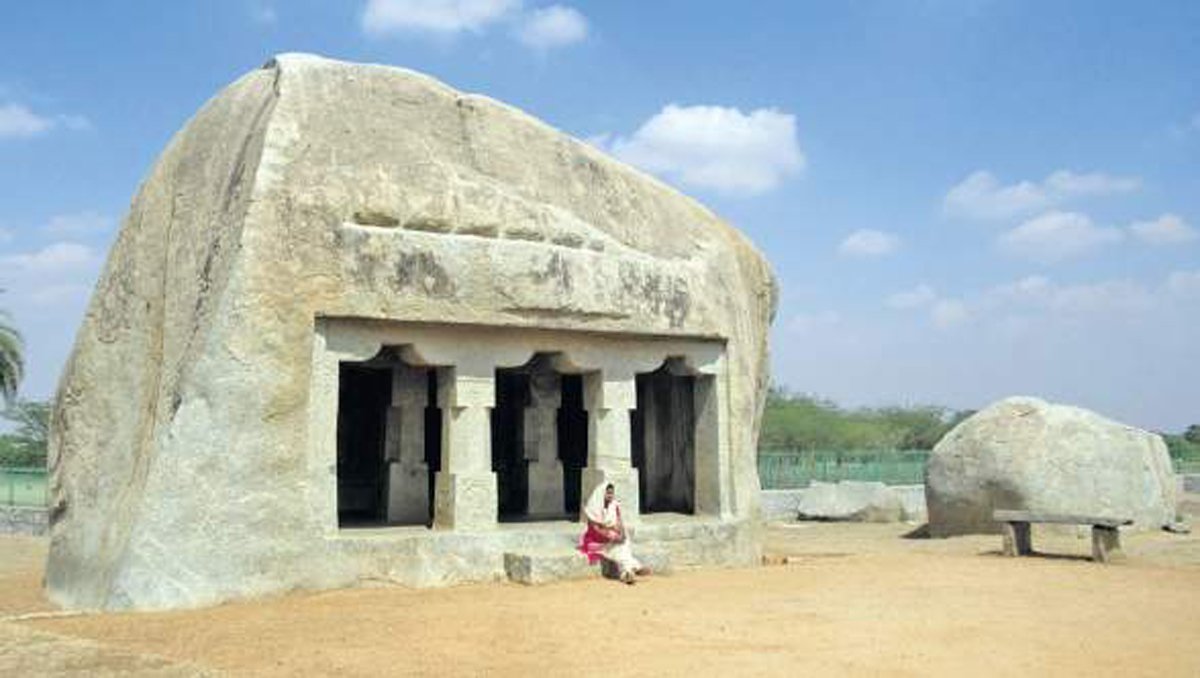
Mahendra-Vishnu-graham – A free boulder, standing amidst green paddy fields, was selected by the Pallava artisans to excavate a shrine enriching the beauty and sanctity of the spot. The eastern face of this boulder turned even out and carved with a temple such as a mukha-mandapa, an ardha-mandapa and garbha-griha inside the rear.
The front façade of the cave is supported on two pillars and two pilasters. Pillars have base and pinnacle cubicle sections (sadhuram) with intervening octagonal elements (kattu). The cubical faces of the pillars are carved with lotus medallions on all 4 sides. The pilasters are left tetragonal throughout. The next row of pillars separates the mukha-mandapa from ardha-mandapa.
These pillars are left undeniable, without the lotus medallions on their cubicle parts. The corbel located above the pillars is curved-profile. The shrine in the rear is flanked with dwarapala, both proven within the identical posture, resting one hand on their waist and the opposite hand pointing towards the shrine. Both wear their yajnopavita in nivita fashion.
The shrine is undertaking outward with its adhisthana (base) composed of decreased number mouldings; jagati, kumuda, kantha and pattika. Rock-cut steps are provided for entry into the shrine. Inside the shrine is positioned a photo of Narasimha, which of course is a later set up. This shrine is of super significance as it is amongst only a few temples, from Mahendravarman duration, committed to Vishnu.
Rathinagiri Bāla Murugan Temple was built around the 14th century. Over the passage of time an everyday sand shape was transformed right into a stone shrine.
Ratnagiri Mulasthanam
Ancient Hindu scriptures say that wherever there is a hill, Lord Murugan is living because of the all-effective Deity. Of those, Thiruparankundram, Tiruchendur, Tiru Avinankudi, Thiruvasagam and Palamuthircholai are famous shrines, together called 'Kundruthoradal'. The holy shrine at Ratnagiri also features in this category.
Arulmigu Ratnagiri Balamurugan temple is an ancient Murugan temple located in Thirukalukundram,Kilminnal,Vellore, India. It became about southside of the river palar. It was built across the 14th century. It is located on top of a hill. Ancient Hindu scriptures say in which there is a hill, there is Lord Murugan. Over the passage of time, and everyday sand structure was converted right into a stone shrine. The 14th Century poet Arunagirinathar has sung about this temple as 'Rathinagiri Vazh Murukane Ilaya Vaaramarar Perumaley', because of this 'Murugan, the God of Devas is living in Ratnagiri'
Agriculture
Agriculture is the prime driving pressure for food protection, rural economy and sustainable socio- monetary improvement of farmers. Agriculture, with its allied sectors, is the biggest livelihood company especially in rural regions.
The government of Tamil Nadu to gain it's imaginative and prescient of Second Green Revolution within the State has taken steps to reinforce farmer-pleasant strategies to increase cropped place; fostering modern crop-unique agricultural practices, to improve farm productiveness and farmers income; designing sturdy infrastructure to transform the prevailing livelihood farming right into a business and dynamic farming gadget; mechanizing agricultural operations to make farming smarter with the aid of saving time and value; enriching farming expertise and empowering farming network through the of ICT; organizing well-established advertising machine and strengthening extension services for massive-scale dissemination of productivity-increasing technologies, potential building and presenting crucial inputs for Farming Communities.
Rainfall
With awesome periods of rainfall and distribution pattern, Ranipet is absolutely depending on monsoon rains for recharging its water assets and thereby, monsoon screw ups result in acute water shortage and intense drought.
Leather Industry
Hundreds of leather-based and tannery facilities lie in and around Vellore, consisting of close by cities which include Ranipet, Ambur and Vaniyambadi. The Vellore district is the pinnacle exporter of processed leather-based goods inside the united states of america. Vellore leather bills for more than 37% of the U.S.A .'s exports of leather and leather-related merchandise (along with finished leathers, shoes, clothes, and gloves).
To know more, please click the below link…
https://renghaholidays.com/