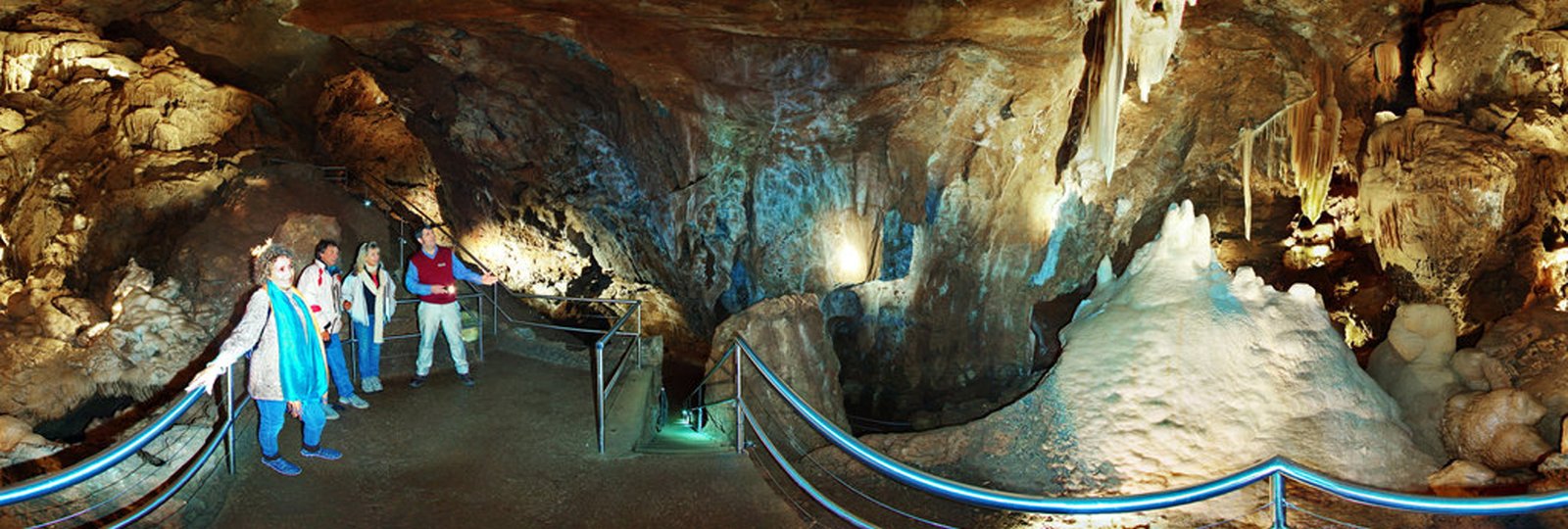
Amazing! Open every day, Jenolan Caves are the world's oldest caves and are considered Australia's maximum amazing. Friendly guides will display you through your choice of eight stunning show caves, for every age and health ranges. Plus there are night time tours, ghost excursions, Adventure Caving, self-guided tour, bush walks, and kids excursions (in NSW faculty vacations). There are a circle of relatives and seniors reductions, plus an extensive range of food and lodging - something for all of us!
Mysterious Jenolan Caves, symbol of splendor, journey, and break out.
For many years, researchers suspected that Jenolan Caves became extremely antique. In 2006, the CSIRO solved the mystery, setting up that the caves are the arena's oldest recognized open caves - 340 million years old. Once hidden and far away, more than 400 caves have been discovered at Jenolan due to the fact that 1830. Their complete volume is the situation of ongoing exploration.
Nature Reserve in World Heritage place
Above ground, there are marvelous formations, such as Carlotta's Arch, the Blue Lake and Jenolan River. It costs you not anything to walk along Jenolan's bush tracks and maybe spot shy native wildlife, such as wallabies and platypus. Jenolan is in National Park, on the western fringe of the Blue Mountains World Heritage area, teaming with native animals, commonly nocturnal.
Explore the Spectacular Caves
In spite of the beauty above the floor, human beings frequently visit Jenolan to revel in the awe-inspiring caves. Underground, with daily guided tours, most site visitors can revel in any of the 8 mind-blowing display caves with their breathtaking formations and rivers.
Each of Jenolan's caves is unique. For instance, the Lucas cave has the Cathedral Chamber, one of the widest and largest at Jenolan. With well-known acoustics, the Cathedral frequently hosts weddings. The Temple of Baal cave, proposing a completely unique sound and light display, gives one of the world's largest cave shawls.
The Orient is one of the maximum beautiful caves inside the world, richly draped with colourful formations. For the less cellular, the Imperial cave is the perfect, with the fewest stair steps. There are many extra caves, each providing wonderful functions.
With so many caves, you could enjoy the underworld in more than a few methods.
Try exploring Jenolan's mysterious depths with Adventure Caving. Abseil, squeeze and climb via undeveloped caves, with only a head lamp to light your manner. There are a range of adventure caving activities, appropriate for beginners to veterans.
If you decide upon exploring at your personal pace, we have a multilingual digital audio excursion of the Nettle Cave, which lets in exploration on a self-guided foundation. This excursion is first rate for folks who do not like enclosed areas!
In this location of haunting splendor, Legends, Mysteries and Ghosts excursion will make you shiver to tales of the unexplained.
Range of Accommodation
Because there may be a lot to do at Jenolan Caves, a few visitors stay numerous nights. Caves House built in 1896, is one in all few ultimate guesthouses of Victorian technology.
We offer a range of lodging from the old-international atmosphere of Caves House itself, to the modern, inn-fashion Mountain Lodge to the backpacker hotel and self-contained cottages.
Caves House features the spectacular, award-prevailing restaurant, Chisolms, which dates lower back to the beginning of the 20 th century. The Caves Cafe gives al fresco eating in the course of the day.
Jenolan is a wonderful base from which to enjoy the Western Blue Mountains and the Central West.
How To Get Here.
From Sydney, take the M4 Motorway journeying west through the Blue Mountains, Katoomba and Mt. Victoria at the Great Western Highway. Shortly after Victoria Pass, the Jenolan Caves turnoff is just past the village of Hartley. Turning left, this avenue passes through Hampton and in the end Jenolan Caves.
Once you are west of Katoomba, the ride offers incredible surroundings on an all sealed road that can be completed with no trouble in 2½ hours from Parramatta.
Jenolan Caves is an iconic traveller attraction: it is seen as Australia's exceptional cave system and a ought-to-see destination. Located within the Blue Mountains close to Oberon, the caves preserve giant prices for plenty of people along with scientists and nature fans.
They are mainly crucial for the local Aboriginal individuals who can recount a dreamtime tale about the advent of the caves: indeed the machine's name originated from the Aboriginal phrase Jenolan which means "high mountain".
The Jenolan Caves additionally have historic significance. In 1866, the Fish River Caves Reserve (unique call) became gazetted as the first reserve in NSW made for the protection of a natural function.
As a tourist vacation spot, the caves were very popular from the outset so to deal with the inflow of sightseers, the first wing of Caves House was constructed in 1897.
In engineering terms, Jenolan boasts another historical first. In 1889 a water-pushed Leffel Wheel changed into a hook near a waterfall on the Jenolan River.
Although built after the 1885 quick-lived Hillgrove hydroelectric scheme, the Jenolan set up persevered to characteristic and went on to become one of the first hydroelectric schemes on mainland Australia. Jenolan became also the website online of the primary ever electric-powered lighting within a cave anywhere within the world.
How Caves Form
Jenolan, with its caves, underground rivers and herbal archways is an example of a form of landform called 'Karst', named after a place in Slovenia, and derived from a Slavic word meaning "bare and waterless".
Jenolan is referred to as an 'impounded' karst, because the limestone gets maximum of its water from the surrounding insoluble rocks. Caves, and other karst features, are produced because limestone is soluble in water which incorporates dissolved carbon dioxide and organic acids.
When rain falls it chooses up atmospheric carbon dioxide. On passing via the soil, extra carbon dioxide from plant roots and decaying vegetable count turns into dissolved within the water, together with complicated natural humic acids. The resultant CO2-wealthy floor water is able to dissolve limestone quite without problems over lengthy durations of time.
Limestone is a sedimentary rock typically shaped in a heat shallow sea where organisms, capable of forming calcium carbonate shells and skeletons, can without problems extract the needed elements from ocean water.
When these animals die, their shell and skeletal debris gather as sediment which may be lithified into limestone. Limestones shaped from this type of sediment are biological sedimentary rocks, evidenced by using the presence of fossils. You can also locate many fossils in limestone, or very few.
At Jenolan, as an instance, the limestone is not the status of a coral reef however consists mainly of quality grained calcite (lime dust) but there are nonetheless many visible fossils.
As the limestone rock mass is lifted up out of the sea or is disturbed through earthquakes or tectonic plate movement, fractures are introduced into the rock permitting water to penetrate more without difficulty, dissolving the calcareous fabric after which depositing it someplace else.
Limestone containing huge cave systems has few pore areas in it, proscribing floor water movement to planes of weakness within the rock (joints, bedding planes and faults). This concentrates the water into structurally managed zones, instead of allowing it to unfold frivolously in the course of the rock.
The solubility of the rock, its mechanical power and the restriction of water to structurally controlled zones integrate to allow the formation of massive, complex cave systems. Fractures widen over time and as underground areas grow there may be similarly cave development as surrounding rock collapses.
Solution cavities in limestone may be completely water crammed: that is referred to as the 'phreatic region'. Water in the phreatic region can be rather nevertheless (nothephreatic) or it is able to be shifting speedy under stress (dynamic phreatic). As the water desk drops, dry spaces stay and cave improvement keeps both thru the movement of floor water getting into the cave environment in addition to the principle body of water flowing through the rock mass.
Features
Away from their entrances, caves typically offer an extraordinarily steady temperature and humidity over an extended period of time. Thus, caves provide a perfect environment for chemical deposition of minerals. Stalactites, stalagmites and other cave formations (regularly known as 'speleothems') are examples of limestone structures that form thru evaporation. In a cave, droplets of water seeping down from above input the cave thru fractures or other pore areas inside the cave ceiling.
There they may evaporate before falling to the cave ground. When the water evaporates, any calcium carbonate that became dissolved in the water will be deposited at the cave ceiling. Over time this evaporative procedure can result in an accumulation of icicle-fashioned calcium carbonate at the cave ceiling. These deposits are known as stalactites. If the droplet falls to the floor and evaporates a stalagmite ought to grow upwards from the cave floor.
Shawls and flowstone
Speleogens can shape in which bedrock isn't uniform in chemical composition. Consequently, through time, the less-soluble rock dissolves slower than adjacent greater-soluble rock.
The much less-soluble rock tends to stand in remedy and projects from the partitions and ceilings of the caves. Sometimes the drip water will glide down the walls and over the cave floor growing flowstone or rimstone deposits.
Where drip water seeps from a joint after which drips over the edges of ledges, deposits of first rate complexity referred to as draperies or shawls are formed. The colour of dripstones and flowstones comes from organic and/or iron oxide compounds delivered in from the floor, giving the speleothems an orange-brown colour, or from the presence of oxides and hydroxides of iron and manganese which give the speleothems a deep brown or black coloration.
Cave systems are crucial for recording environmental adjustments, which includes species distribution. Animals can wander into caves and become misplaced, dying in low-humidity surroundings which could maintain their bodies for 'brief' time periods, or if protected with sediment, for 'lengthy' periods. Within Jenolan Caves, Tasmanian Devil skeletal remains have been exposed.
A spectacular herbal surprise
Jenolan Caves is one among Australia’s national treasures - the sector’s oldest and Australia’s maximum awe-inspiring caves, with staggering formations and natural underground rivers. Draped with limestone crystal, each of our many caves is outstanding in its own way. Some are large and hung with gigantic formations of tens of millions of years antique.
Others are intimate and mysterious, forested with the most sensitive crystal. Our Orient Cave is reputed to be one of the world's most stunningly beautiful caves.
The dark, mysterious underworld is unspoiled, a party of nature’s glory, a visible feast. Even if you no longer like enclosed spaces, you will be amazed in our widespread Nettle Cave, where you can see certainly one of our strangest treasures – stromatolites.
Our self-guided audio excursion is straightforward to use and to be had in lots of languages!
Australian native animals
As Jenolan Caves is nestled in blanketed barren region inside the Blue Mountains World Heritage Area, in the early morning or at nightfall, in case you are patient, you can spot diverse shy Aussie animals - wallabies, kangaroos, wombats, lyre birds and more. Rare platypus are visible every day in our mountain lake – just a stroll from the caves.
Challenge of Adventure Caving
Adventure Caving is a severe enjoy for venture seekers. For health, learning and self assurance-building, our Adventure Caving allows ordinary people to face and conquer their fears deep within the coronary heart of a mountain, without risking their lives!
To know more, please click the below link...
https://renghaholidays.com/